
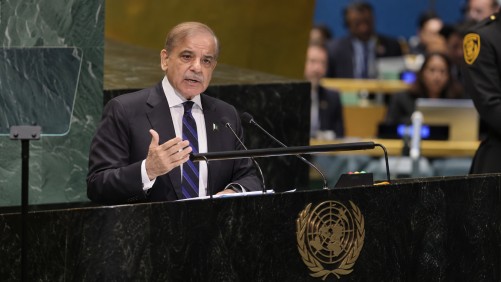
During the 81st session of the United Nations General Assembly, Pakistan’s Prime Minister Shehbaz Sharif acknowledged the role of former US President Donald Trump in defusing a military standoff between Pakistan and India in May 2025. Sharif credited Trump’s “timely intervention” with averting a potential escalation between the two nuclear-armed nations. Despite Sharif’s remarks, India has maintained that the ceasefire was achieved through direct communication with Pakistan, without any third-party intervention.
Highlighting the tensions between the two countries, Sharif reiterated Pakistan’s stance on the Indus Waters Treaty. He criticized India’s decision to place the 1960 agreement in abeyance, emphasizing the treaty’s significance for Pakistan and the broader region. The Indus river system, he argued, is vital, and any attempt by India to stop, impede, or divert Pakistan’s share of the waters would be seen as an “act of war.” Sharif asserted that international legal developments support Pakistan’s position on the treaty’s continued validity.
In response, India firmly rejected Pakistan’s allegations regarding the Indus Waters Treaty and reiterated its right to self-defense against terrorism. During its right of reply at the UN, India accused Pakistan of perpetuating cross-border terrorism, warning that such actions would have consequences. India’s stance remains unchanged, emphasizing its commitment to defending itself against threats.
Sharif also defended Pakistan’s military actions during the 2025 confrontation, underscoring the country’s right to self-defense under Article 51 of the UN Charter. He commended the Pakistani armed forces for their conduct during the conflict.
The Indus Waters Treaty, a pivotal agreement signed in 1960 between India and Pakistan, governs the distribution and utilization of the Indus river system waters. The treaty has long been a source of tension between the two nations, with both sides asserting their rights and interpretations of the agreement.